Abstract: From the European Union and South Korea to China, Japan, and Australia, MEKO (butyraldehyde oxime) regulations have shifted from labeling-based oversight to limit-based control. The release of MEKO during the curing process of oxime-based RTV silicone resins is becoming an EHS “red line” for electronics manufacturers expanding overseas. COHUI has launched two eco-friendly electronic silicone resin products CHMS704 and CHSN704 .which do not release MEKO, thereby addressing the triple challenges of product compliance, occupational health, and electronic reliability.
The global wave of chemical regulation is gaining momentum; MEKO (butanone oxime) is no longer merely a “odorous by-product” it has been classified by numerous countries as a Carcinogen 1B a potential carcinogen and represents a critical EHS compliance threshold that the electronics industry must address.
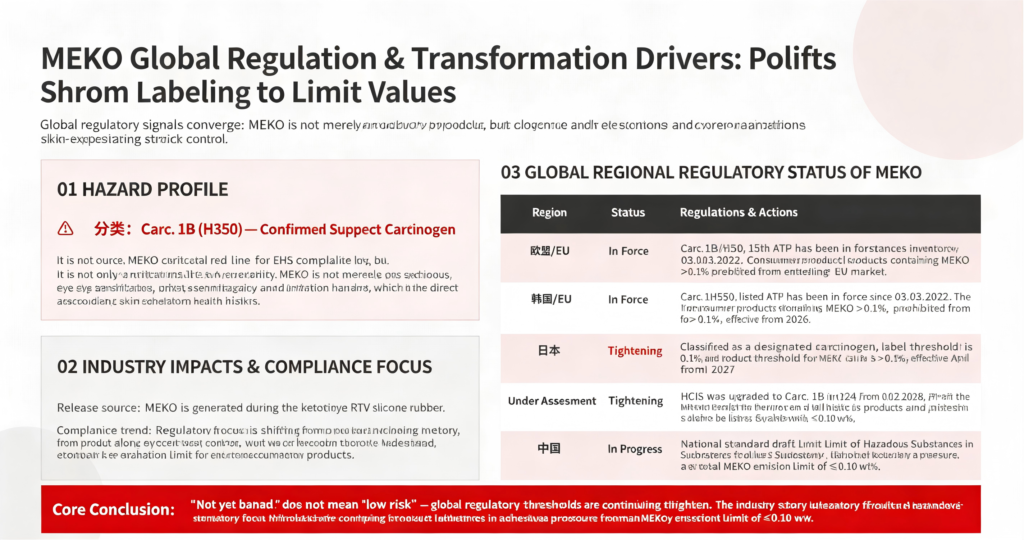
✅ Global regulatory tightening is accelerating, putting mounting pressure on export-oriented enterprises.
EU: The regulation has come into force; the sale of consumer products with a MEKO content exceeding 0.1% is prohibited;
South Korea: To be officially implemented in 2026; substances with an MEKO threshold> 0.1% will be included in the Hazardous Substances List;
Japan: Designated as a specific carcinogen effective April 2027; mandatory retention of occupational exposure records for 20 years;
Australia: Currently assessing an upgrade to its classification system; limit-based regulatory controls will be implemented by 2028;
China: The national standard “Maximum Allowable Limits of Hazardous Substances in Adhesives” is being promoted, imposing a limit on the total MEKO release amount of ≤0.10 tw%.
The regulatory landscape is clearly shifting: the focus of oversight is moving from simple product labeling to production process control, worker occupational exposure monitoring, and maximum concentration limits for end products. Many companies still assume that “not yet banned” equates to “low risk”; however, the barriers to market entry in overseas markets are continuously rising, and the traditional MEKO-based silicone curing process – which releases MEKO – is now becoming a bottleneck for securing international orders.
MEKO entails two major core risks:
Personnel health risks: causes severe ocular injury, skin sensitization, target organ damage, and inhalation toxicity;
Product risk: MEKO, a wet-curing agent used in RTV formulations, releases volatile compounds; these small-molecule volatiles can easily accumulate at circuit contacts, leading to corrosion or short circuits and thereby compromising the long-term stability of electronic products.
👉 COHUI Dual Series – featuring MEKO-free eco-friendly silicone – directly addressing compliance challenges
✅ CHMS704 Modified Electronic Silicone Rubber | Free from D3–D10 small-molecule volatiles
Utilizes silane-terminated polymer technology; no MEKO release; silicone-free; extremely low odor.
Featuring medium modulus and high strength, it prevents the volatilization of D3–D10 cyclic polydimethylsiloxane small molecules, thereby avoiding circuit corrosion or short circuits.
Multiple models are available to meet diverse requirements for viscosity, flame resistance, and thermal conductivity; suitable for high-reliability applications such as aviation, aerospace, medical electronics, optoelectronics, smart automotive electronics, and low-altitude aircraft systems.
✅ CHSN704 Alcohol-Based Eco-Friendly Silicone Rubber | Alcohol-based formulation, low VOCs
Utilizes alkoxysilane-terminated silicone polymers that do not release MEKO, contain no formaldehyde, low VOCs, and are non-corrosive.D3–D10 content <500 ppm; wide temperature range; paste-based formulation – meets stringent environmental compliance requirements for medical devices, household appliances, and consumer electronics.
Two major products, covering various application scenarios:
Whether for high-end, high-reliability aerospace electronics or overseas expansion projects in consumer electronics and medical devices, Kehui’s MEKO silicone solution addresses three major challenges simultaneously: compliance and customs clearance, worker occupational health, and long-term circuit reliability.
Compliance is not just an optional choice it’s the ticket to entering the future of the electronics manufacturing industry.
Kehui Materials has proactively deployed its MEKO eco-friendly silicone technology, facilitating the successful expansion of China’s electronic products into the global market.